
Functionality – through the eyes of an OT

Functionality – through the eyes of an OT
Here I am sitting with my hands paused on the keyboard thinking about how to put on paper what I have running through my mind. I stare down at my hands and I see exactly that, a pair of hands. I also see my reason for choosing to become an Occupational Therapist.
Being an occupational therapist doesn’t have a “set” job description. What I mean by this is that your job description depends in which field of occupational therapy you find yourself practicing this allied health profession. Many people link OT with children. Giving therapy to children would mean that you are working in the pediatric field. Within this field of pediatrics you can once again choose to work in an area of specialization, whether you specialize in sensory integration or neurodevelopment etc.
Basically you can divide occupational therapy into a physical and psychiatric setting and then you can divide these settings into fields. Each setting consists of three fields – pediatrics, adults and geriatrics. Specialized areas are unique to each field. For instance in the physical field you may choose to work/specialize in neurology, orthotics & other injuries (other injuries would include burns), vocational rehabilitation, medicolegal or my personal favorite, hands.



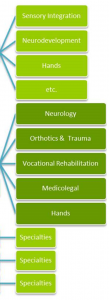
Although OTs might find themselves in different settings, fields or specialized areas, we all have the same ultimate goal – to improve or maintain functionality. So then the next logical question is: What does it mean to be functional? For this article we will focus on the physical setting and adult field.
Being functional essentially means being able to do what you need to do. Think of what it is you do from the moment you open your eyes in the morning till you open your eyes again the next morning. Take your time… A lot of stuff, right? Remember your list – we will get back to it.
So let me ask you a question. With an open mind, imagine this with me for a second.
What if you had an accident and became paralyzed from the waist down? Would you consider yourself to be functional?
What if you had a brain injury? Would you still be functional?
What if you had an amputation of a limb or a finger? Would you then be functional?
Maybe you had a serious surgery or injury like a burn wound and now have lost your ability to fully move that part of your body? Are you functional?
Now think of your list we mentioned earlier, would you be able to do all the things on your list if you were to find yourself in one of the situations mentioned above?
If your answer is no, I have good news for you, you are wrong! I will tell you why in a bit 😉 .
If your answer is yes, I am very glad you have such a positive outlook!
Yes you can still function and be functional. The big question however is – HOW?
And this, my friends is why there is such an awesome career as being an occupational therapist. Remember OTs improve or maintain functionality. How we do that is unique to each person’s situations. We follow a person centered approach. Therapy can include a variety of strategies to improve or maintain that person’s functionality: muscle strengthening, adapted methods of execution (different ways of doing something, definitely not carrying out a sentence of death in this case! Rather the opposite 🙂 ], using assistive devices, adapting the environment etc. There are many case management techniques.
So yes, the answer is definitely yes! You can still be functional and you can achieve this with the help of an Occupational Therapist. A person centered approach, as I have mentioned, is unique which also means that the professionals of which the therapy team is composed off is also unique. What I mean by this is that your therapy team might consist of more than just an Occupational therapist and might include other professionals like a physiotherapist or dietician etc. It is however important for professionals to work together as a multi-disciplinary team to provide holistic treatment.
I hope I have provided an understandable overview of Occupational Therapy in this article and that you are motivated to read other articles to follow.

Chanel Vlok McCabe Occupational Therapist
Author of Hand Matters Blog
One Response
Poids est comment dur votre sang pousse contre les parois de vos arteres lorsque votre coeur determination pompe le sang. Arteres sont les tubes qui transportent perseverent b gerer offre sang loin de votre coeur. Chaque age votre coeur bat, il pompe le sang tout au long vos arteres a la reste de votre corps.
https://www.cialispascherfr24.com/tadalafil-100mg/